Midterm Elections: States That Will Decide Control of Congress and Trump’s Future



Posted on 10/17/26 at 14:02
With an approval rating near 37%, Donald Trump faces crucial elections. A small group of districts and states could change the political balance in Washington.
The November 3 midterm elections will determine which party will control the US Congress during the last two years of Donald Trump’s term.
– Why it matters: A Democratic victory in either chamber could limit the Republican legislative agenda and increase oversight of the White House.
Trump Heads into Midterm Elections with 37% Approval Rating
Where the US midterm elections will be won and lost https://t.co/d259xepMM6
— BBC News (World) (@BBCWorld) October 13, 2026
The president faces a decline in popularity that coincides with the preparation of legislative elections, according to data from Silver Bulletin.
Trump began his second term with an approval rating above 50%, but the indicator quickly dropped to around 40%.
After the US and Israeli attacks on Iran, which began in late February, his approval rating fell below that level.
– The fact: The cited measurement puts his approval rating at around 37%, compared to 43% at a similar point in his first term.
History offers important precedents, although it does not determine the results of November.
Since 1934, the presidential party has lost an average of 27 seats in the House during midterm elections.
21 Districts That Could Change the House of Representatives
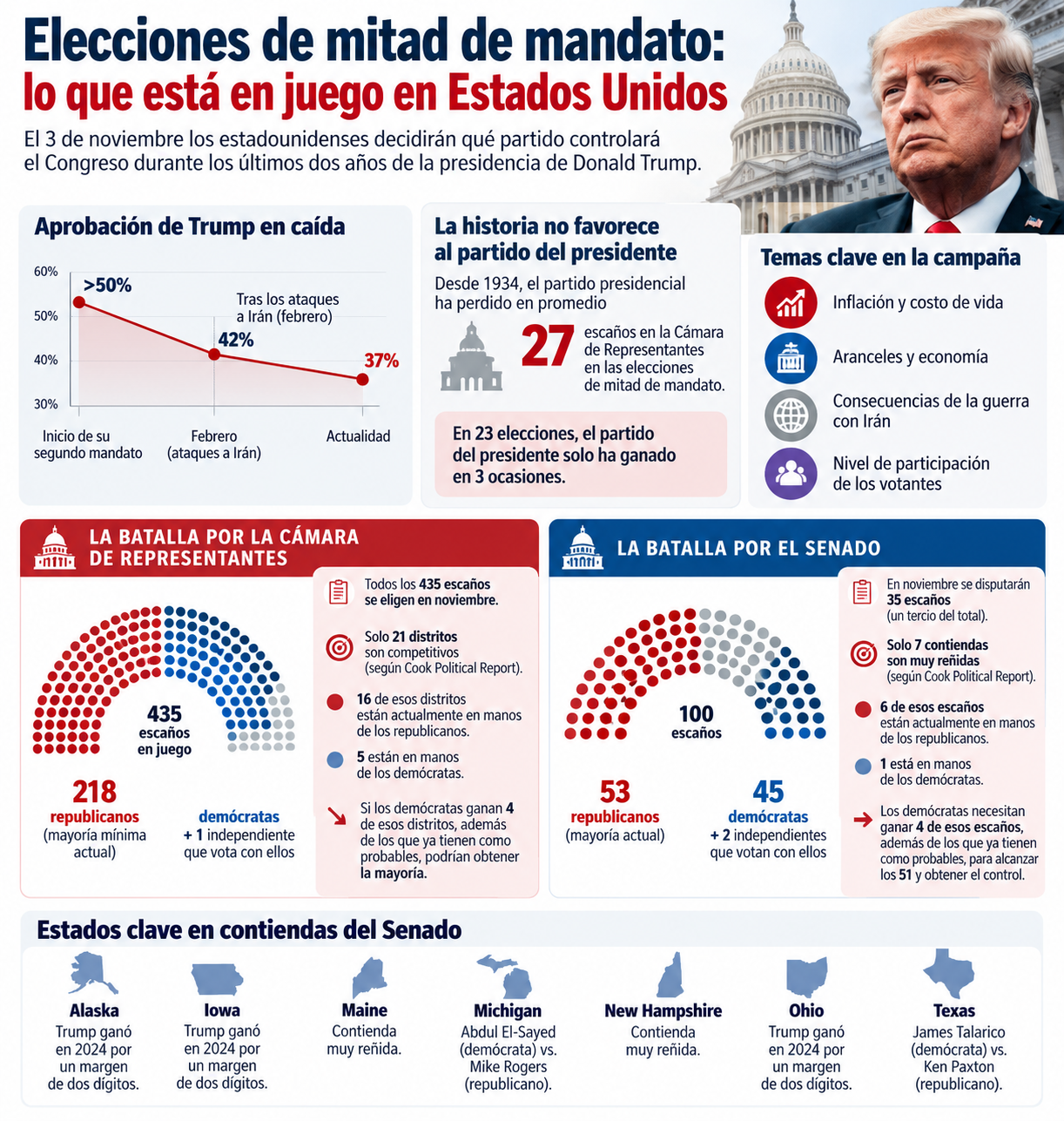
Republicans maintain an extremely narrow majority in the House of Representatives, where all 435 seats will be contested.
According to the Cook Political Report classification included in the material, only 21 districts have contests considered particularly competitive.
YOU MAY BE INTERESTED: Trump receives a judicial setback: judge blocks veto against CNN, Politico, and MS NOW at the White House
Of those districts, 16 are currently represented by Republicans and five by Democrats, a relevant distribution for the legislative dispute.
– The difference: Democrats need to achieve enough additional victories to exceed the threshold of 218 seats, also considering less competitive districts.
The House has the power to pass laws, control federal funds, and initiate investigations into government actions.
Therefore, even a small change in seats could modify budget negotiations and the relationship between Congress and Trump.
Seven States Concentrate the Dispute for the Senate
The Senate presents a different challenge: Republicans control 53 seats, and Democrats need a net gain of four to reach 51.
Alaska, Iowa, Maine, Michigan, New Hampshire, Ohio, and Texas appear among the most competitive contests in October’s electoral classifications.
– The process: Senators serve six-year terms. In November, 35 seats will be contested, including those corresponding to special elections.
Michigan faces a contest between Democrat Abdul El-Sayed and Republican Mike Rogers for a seat currently held by a Democrat.
Texas also draws attention due to the matchup between James Talarico and Ken Paxton, in a state without Democratic senators since 1993.
Cost of Living and Turnout Will Mark November
Inflation, tariffs, and the economic consequences of the war with Iran are among the issues that cross several campaigns.
Economic concerns have also led Republican candidates in competitive states to distance themselves from some of Trump’s trade policies.
– What voters can do: Voters can check their districts, verify their voter registration, and review early voting dates in their states.
The outcome will depend on millions of individual decisions, especially in competitive districts where small differences in votes can change representation.
A divided majority between parties could also force Trump to negotiate his proposals with an opposition that controls part of Congress.