Ethereum Drops: What Happened to Ether and Why the Fed Is Being Discussed


Posted on 11/16/26 at 15:23
If you saw Ethereum in the red on Sunday, November 15, you weren’t alone. Note one detail: Ethereum is the network, and ether (ETH) is the cryptocurrency used within it. What fell was the price of ether. At 7:38 a.m. ET on November 15, in the Coinbase Exchange, the ETH-USD pair marked $1,829.11, compared to $1,898.32 at the start of the 24-hour window. That’s a drop of approximately 3.65%.
What exactly happened to the price of ether?
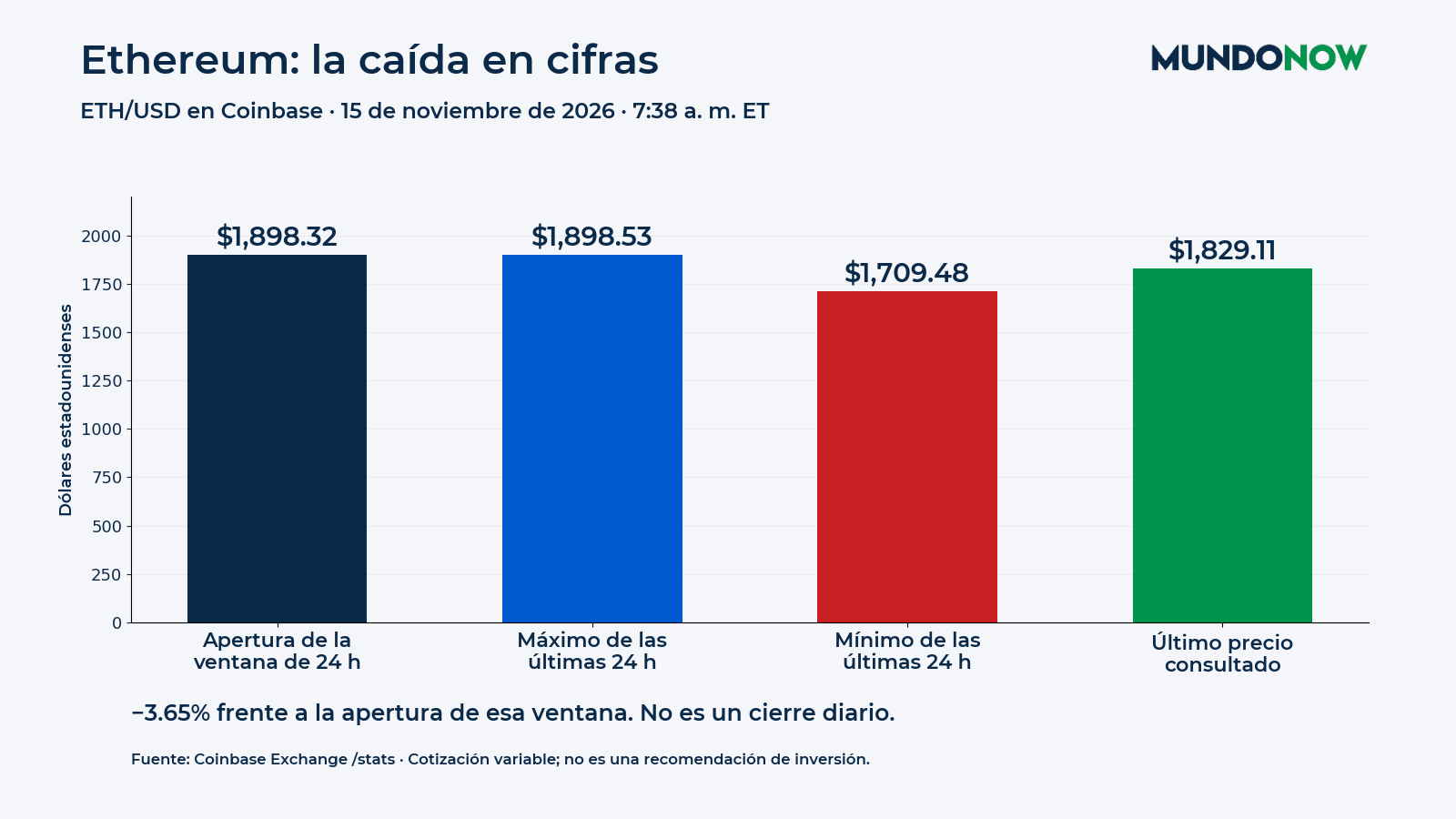
According to Coinbase Exchange data, in those 24 hours, ether reached a maximum of $1,898.53, almost equal to the opening, and a minimum of $1,709.48. That is, it fell sharply during the window and, at the time of the query, was above that floor, although far from where it started.
An important clarification: this figure comes from a single market and a 24-hour window. It’s not a daily close or the price of the entire market. Additionally, it’s a snapshot from 7:38 a.m. ET on November 15. When you read this, the price may be different, and nothing guarantees that it will rise or continue to fall.
What does the Fed have to do with it?
According to a Dmarketforces report on November 15, there was a generalized sale in cryptocurrencies, and ether fell more than bitcoin. The medium relates that pressure to three factors: expectations of new Fed rate hikes, reported outflows from exchange-traded funds (ETFs), and the liquidation of buying positions.
Is it proven that rates caused the drop? No. It’s the context that report raises. What is documented is that Susan Collins, from the Federal Reserve Bank of Boston, said on October 13, 2026, that she expected it would be appropriate to raise rates somewhat more before the end of the year, always based on the data. It was an October stance: not a November 15 statement or a decision by the Fed’s monetary policy committee.
Who loses and who might see something different in a drop like this?
Those who already have ether. They see their investment worth less in the short term. For those who need that money soon, volatility is a real risk: the price can move a lot in a few hours, as shown by the range of this window.
Those thinking of entering. A lower price may seem like a better entry point. But a lower price is not a guaranteed opportunity: the price can continue to fall. That’s why many wonder how much they could lose without it affecting their ability to pay rent, food, and basic bills.
Those operating with leverage. That is, with borrowed money to bet bigger. In that type of operation, both gains and losses are amplified, and if the price moves against, the position can be forcibly liquidated. According to the Dmarketforces report, the liquidation of buying positions was one of the factors of pressure on the price.
Those looking at rates from outside cryptocurrencies. Higher rates usually make credit more expensive for families and businesses and can also change the attractiveness of riskier assets. How that weighs in each case is part of the debate among analysts, and there’s no single answer.
What can you do with this information?
This is not a personal investment recommendation or a call to buy the dip. Ask yourself what part of your money is exposed to risk, how much you can afford to see drop, and if you understand what you have. And remember: there’s no guaranteed return.
If you want to keep investigating, in previous MundoNow articles, we explained how cryptocurrencies intersect with inflation data (IPC and IPP), what a rate hike in December could mean for your money, and how a bitcoin and crypto market drop played out. These are previous texts, not November 15 news, but they help you understand the context. Before moving a dollar, ask yourself: what am I willing to lose?
Sources: Coinbase Exchange, ETH/USD statistics, query on November 15 at 7:38 a.m. ET; Dmarketforces, November 15 report; Federal Reserve Bank of Boston, Susan Collins, October 13, 2026. Data consulted on November 15, 2026.