Life Keeps Getting Pricier: Inflation, Mortgages, and Interest Rates Pressure Families



Posted on 11/16/26 at 09:48
Downward Trend: Food, housing, and service prices continue to rise as mortgages surpass 7% and Treasury bonds forecast more pressure on credit costs.
November 16, 2026 | Economy and Finance
Why it Matters: For millions of families in the United States, especially those living paycheck to paycheck, the economic problem is no longer just about how much it costs to fill a grocery cart. It’s also about how much it costs to finance a home, buy a car, pay credit card bills, and maintain a family budget that seems to stretch less and less each month.
The Essentials
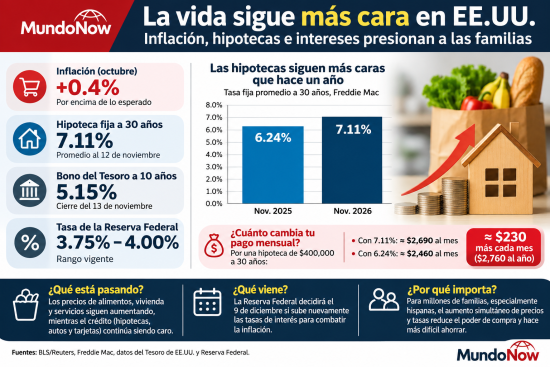
- Inflation rose 0.4% in October, above the 0.3% expected by economists.
- 30-year mortgages average 7.11%, compared to 6.24% a year ago, according to Freddie Mac.
- The 10-year Treasury bond reached 5.15% on November 13, a significant indicator of future credit costs.
- The Federal Reserve maintains its reference rate between 3.75% and 4.00%, while markets anticipate the possibility of another increase in December.
Prices Continue to Rise, Although More Slowly
The latest inflation report from the Department of Labor confirmed what many families experience when paying their bills: the pressure on their wallets continues.
Consumer prices increased 0.4% in October, after rising 0.6% in September. Although the monthly pace slowed, the result exceeded expectations and moved away from the possibility of quick relief.
Annual inflation had reached 3.7% in September. The government did not release an official annual comparison for October because the 2025 federal shutdown prevented the collection of necessary data for that month.
According to Reuters and The Washington Post, food, electricity, and various essential services continue to pressure budgets. Food prices recorded their largest monthly increase since April.
The difference is important: a decrease in inflation does not necessarily mean that prices are going down. It means that, overall, they are increasing at a slower pace.
Buying a Home Remains a Challenge
Mortgage rates recorded four consecutive weeks of declines, but still remain at levels that make buying a home difficult.
According to Freddie Mac, the average rate for a 30-year fixed mortgage fell from 7.18% to 7.11% during the week ending November 12. However, a year ago it was 6.24%.
The difference may seem small, but it has significant consequences for a family trying to buy their first home.
For example, financing $400,000 over 30 years with a 7.11% rate represents an approximate monthly payment of $2,690, just in principal and interest. With a 6.24% rate, that payment would be around $2,460.
That’s approximately $230 extra per month, or $2,760 per year, not including property taxes, insurance, maintenance, or possible association fees.
For many buyers, that difference determines whether they can qualify for a mortgage or if they must continue renting.
The Concerning Signal Comes from the 10-Year Bond
While public attention often focuses on Federal Reserve decisions, another indicator can be just as important for those seeking financing: the yield on the 10-year US Treasury bond.
That yield reached approximately 5.15% on Friday, November 13, after rising significantly during the previous days.
Why does it matter?
Because long-term mortgage rates tend to move in relation to the yield on these bonds. When investors demand higher yields to lend money to the US government, banks may also face higher costs to finance mortgage loans.
The Federal Reserve primarily controls short-term interest rates, but does not directly determine how much banks charge for a 30-year mortgage.
That’s why, even when mortgage rates fall for a few weeks, a new increase in Treasury yields can reverse part of that relief.
The Federal Reserve Faces a Difficult Decision
Inflation continues to exceed the Federal Reserve’s 2% target, while households face high costs and a weakened housing market.
The central bank maintained its reference rate between 3.75% and 4.00% in October, after having raised it in September.
Now, several economists consider it likely that there will be another increase in December to contain inflation.
But there is a dilemma: raising rates could help slow down prices, although it would also make financing more expensive for businesses and consumers.
Journalistic and Economic Sources
-
Reuters — October Inflation Report and Fed Perspectives. Published on November 10.
-
The Washington Post — Food and Electricity Prices. Published on November 10.
-
Freddie Mac — Official Mortgage Rates. Published on November 12.
-
Associated Press — Housing and Mortgage Rates. Published on November 12.
-
Investing.com — 10-Year Treasury Yield. Published on November 16.