US Inflation Rises 0.4% in October: Will the Fed Raise Rates in December?


Posted on 11/11/26 at 16:12
If you thought prices were finally giving you a break, the latest October 2026 inflation report offers an unwelcome reminder that the cost of living remains under pressure. The US Consumer Price Index (CPI) rose 0.4% from September, while core inflation, which excludes food and energy, increased 0.3%. Both figures exceeded economists' expectations. We're updating our November 8 report to explain what the latest numbers reveal and why they matter for your finances.
What Does the October 2026 Inflation Rate Report Show?
According to Commerzbank's November 10 analysis, core inflation rose 0.3%, exceeding economists' consensus forecast of 0.2%. CNBC reported that economists expected overall inflation to increase 0.3%, but the actual figure was 0.4%. In other words, both readings came in higher than anticipated.
Commerzbank also highlighted increases in several everyday expenses: food prices rose 0.5%, gasoline prices climbed 1.0%, and transportation services increased 0.8%. Remember that these figures represent monthly changes in national price indexes. They don't mean every grocery item became 0.5% more expensive or that your household expenses increased by precisely those amounts. Individual experiences can vary significantly.
[caption id="" align="alignnone" width="1600"]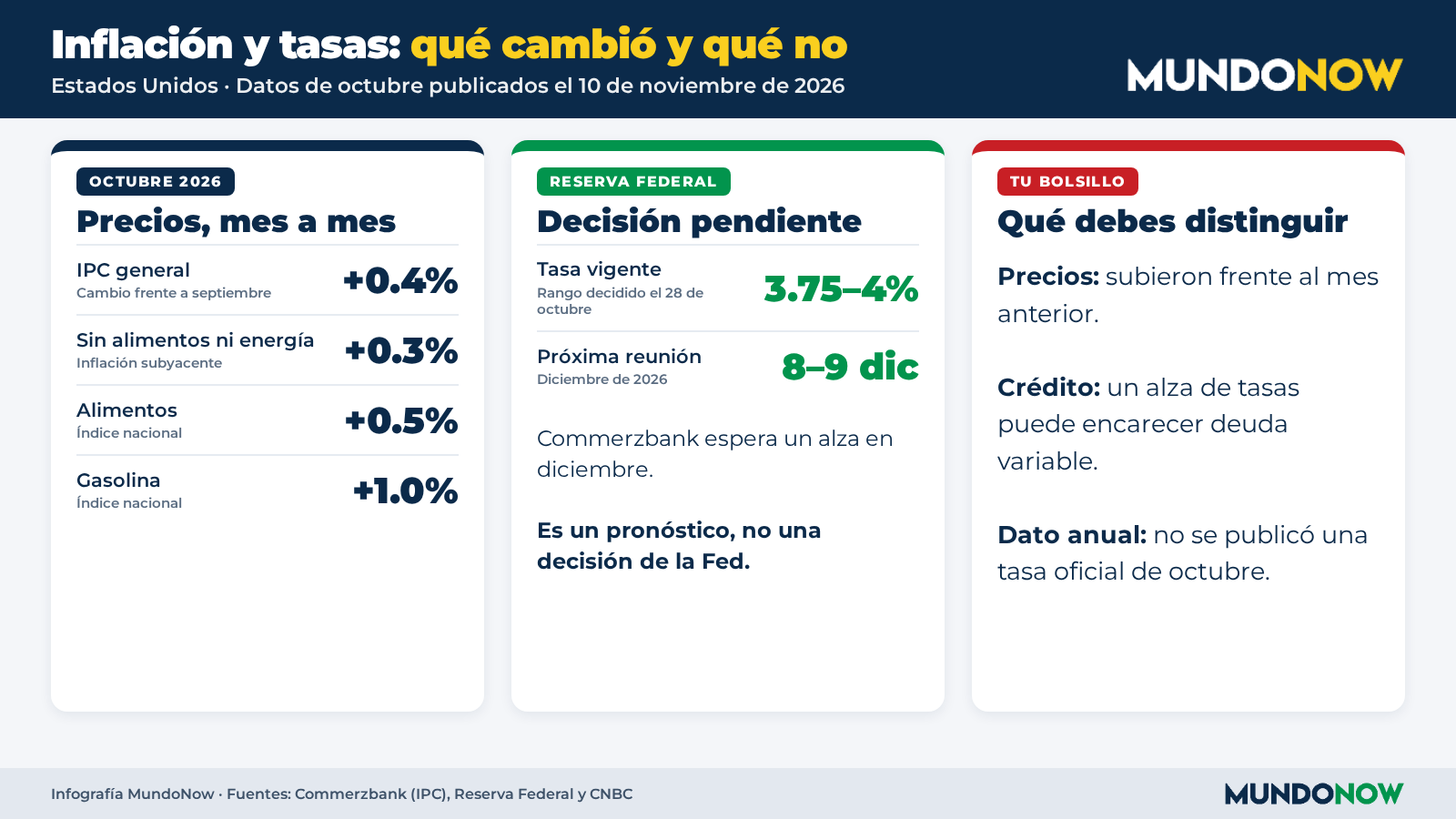 October 2026 inflation rate - Infographic: MundoNow.[/caption]
Why Isn't the Annual Inflation Rate Available for October?
You might wonder why the government released monthly inflation figures without the usual annual comparison. The explanation dates back to October 2025, when a federal government shutdown interrupted the collection of consumer price data. Because the Bureau of Labor Statistics (BLS) could not publish most price indexes for that month, it cannot calculate official 12-month inflation rates for October 2026 for those categories.
What Did the Fed Decide, and Could Interest Rates Rise in December?
At its October 28, 2026, meeting, the Federal Reserve kept its benchmark interest rate unchanged at 3.75% to 4.00%. The decision passed by a 10–2 vote, with Fed officials Lisa Cook and Beth Hammack favoring a quarter-percentage-point increase instead. The central bank acknowledged that inflation remains elevated and reaffirmed its commitment to its 2% inflation target.
Has the Fed already decided what to do next? No. Its next policy meeting is scheduled for December 8–9, and no rate decision has been announced. Commerzbank expects an interest rate hike in December, but that remains the bank's forecast rather than an official Fed decision. Its analysts argue that persistent price pressures, strong economic activity, and the ongoing conflict in the Middle East make a rapid decline in inflation unlikely.
How Could Higher Interest Rates Affect Your Money?
Let's look at the possible effects rather than assume a rate hike is inevitable. When the Fed raises interest rates, borrowing can become more expensive, particularly for variable-rate loans, credit cards, and new financing. That can put additional pressure on households already struggling with higher prices. However, your mortgage or other loan payments won't necessarily change immediately. The impact depends on your interest rate, contract terms, and lender.
On the other hand, some savers could benefit from higher yields on savings accounts, certificates of deposit, and other interest-bearing products. Those increases aren't automatic, however, and banks don't all adjust their rates at the same pace.
Businesses also face pressure from higher operating expenses and, if interest rates increase, more expensive financing. That combination can discourage investment, slow hiring, or lead companies to pass additional costs on to consumers.
The Federal Reserve faces a difficult balancing act. Raising interest rates can help reduce inflation by slowing economic demand, but it can also weaken economic growth.
Here's an important distinction: lower inflation doesn't necessarily mean lower prices. It usually means prices are rising more slowly. Products that have already become more expensive won't automatically return to their previous prices.
What Can You Do Before the Fed's December Meeting?
There's no need to panic, but this is a useful time to review your household budget. Check how much you're spending on gasoline, groceries, and transportation, three categories highlighted in Commerzbank's latest analysis. If you have variable-rate debt, consider how a higher interest rate could affect your monthly payments. The goal is to understand your financial situation before the Fed announces its next decision.
If you'd like more context, read our previous explanation of how a potential December rate hike could affect your money. You can also revisit our report on the Fed's October interest rate decision to understand why policymakers held rates steady. Together, these reports raise an important question: how would your budget be affected if prices continued rising and borrowing costs increased?
Sources: Commerzbank: inflation analysis on November 10; Federal Reserve: decision on October 28; CNBC: October CPI report. Data consulted on November 11, 2026.