October Jobs Report: 165,000 New Jobs, Unemployment at 4.1%



Posted on 11/07/26 at 14:38
The October jobs report from the Bureau of Labor Statistics (BLS), released on Friday, November 6, brought a positive surprise: nonfarm payrolls rose by 165,000 jobs, and the unemployment rate stood at 4.1%, down from 4.2% in September. According to USA Today, the figure exceeded forecasters’ expectations, following months of sharp fluctuations in hiring.
- The 165,000 new jobs surpassed the monthly average of 48,000 over the previous 12 months.
- The unemployment rate for Hispanics was 4.7%, unchanged from September.
- Wages rose 3.1% over 12 months, but 339,000 more people are working part-time, although they would prefer full-time work.
Why it matters: employment and wages determine how much you take home in your paycheck and how easy it is to find a job. A strong month is good news, but the underlying numbers show a labor market with lingering weaknesses.
Where the jobs were created
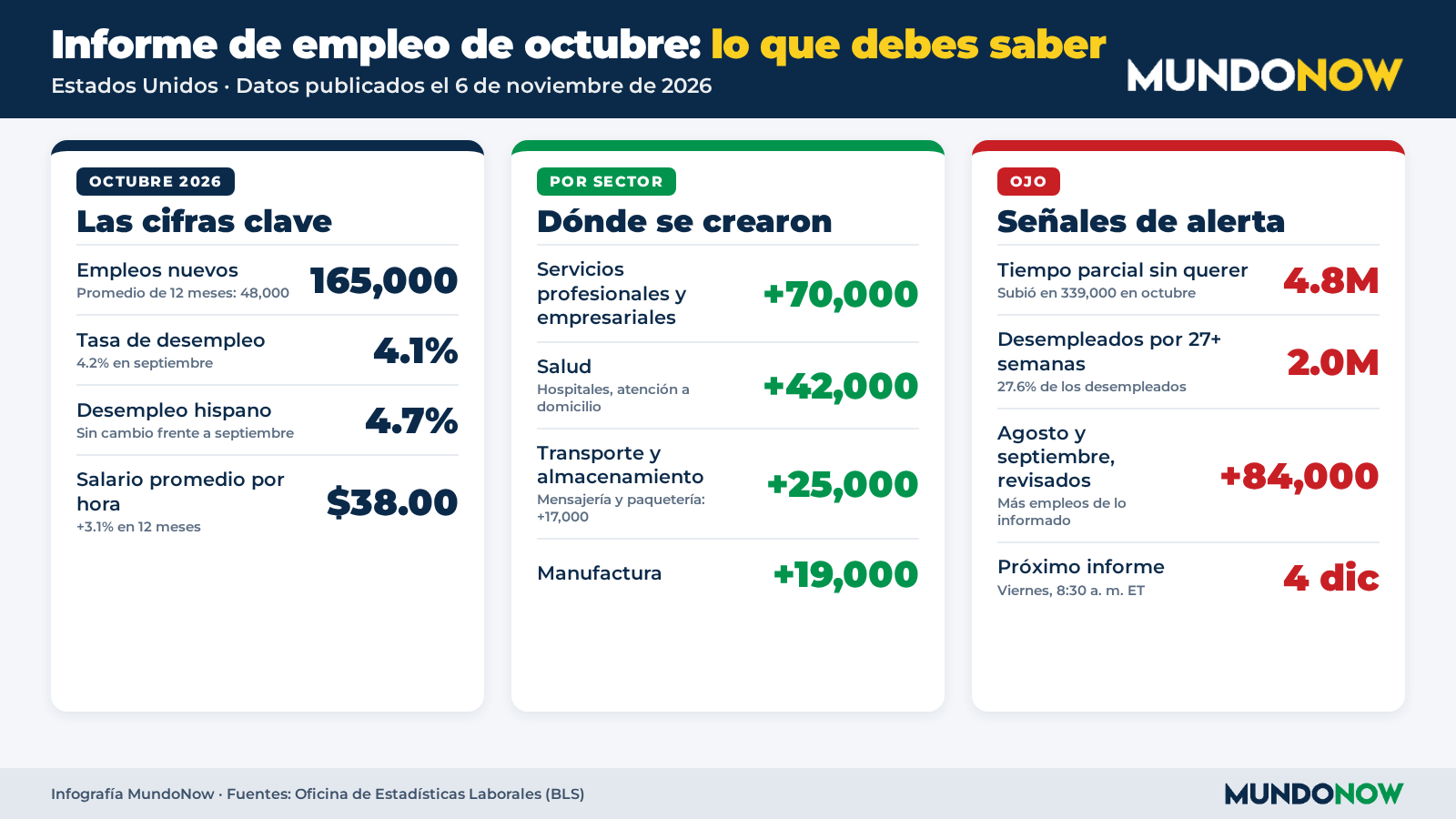
Professional and business services led the gains with 70,000 jobs: 33,000 in professional, scientific, and technical services, and 28,000 in administrative and support services. Healthcare followed with 42,000 jobs (hospitals, 16,000; home healthcare, 11,000; outpatient care centers, 5,000).
Transportation and warehousing added 25,000 jobs, with 17,000 in couriers and messengers and 4,000 in air transportation. Manufacturing added 19,000 jobs. In contrast, construction, retail trade, leisure and hospitality, and government showed little change. If you’re looking for a job, those first sectors are where most of the hiring took place.
How Hispanic workers fared
The unemployment rate for Hispanics was 4.7% in October, unchanged from September. It is higher than the national rate (4.1%), the rate for whites (3.7%), and the rate for Asians (2.8%), and lower than the rate for blacks (6.6%). Among adults, the rate was 3.9% for men and 3.6% for women; among teenagers, it reached 13.9%.
In other words, the strong hiring month did not translate into a measurable improvement for Hispanic workers. Nationally, the rate has been moving between 4.1% and 4.3% since March.
Wages: what happened to your paycheck
The average hourly wage in the private sector rose 14 cents (0.4%) to $38.00. Over 12 months, the increase is 3.1%. For production and nonsupervisory employees, the average wage rose 12 cents (0.4%) to $32.75. The average workweek was 34.4 hours.
These are averages: your situation may vary depending on the sector and position. It’s a good idea to compare that 3.1% increase to the rise in your rent, food, and transportation costs, and keep it in mind if it’s time to ask for a raise.
Warning signs
The clearest warning sign is involuntary part-time work: the number of people working part-time for economic reasons, i.e., those who wanted full-time work, rose by 339,000 to 4.8 million. Many people have jobs, but not the hours they need to cover their expenses.
There are also 7.1 million unemployed people, and 2.0 million have been without work for 27 weeks or more, 27.6% of the total. The labor force participation rate is 61.9%, and the employment-population ratio is 59.3%.
Additionally, revisions showed a slightly better-than-expected picture for previous months: August rose from 133,000 to 186,000 jobs, and September from 29,000 to 60,000, for a total of 84,000 more jobs than previously reported. Still, the fluctuations of recent months recommend caution. If you want to review your budget and savings, check out how to protect your family’s finances.
What’s next
The next report, for November, will be released on Friday, December 4, 2026, at 8:30 a.m. ET. In the meantime, if you’re looking for a job, it’s worth checking out job openings in professional services, healthcare, transportation, and manufacturing. If you’re already working part-time and need more hours, ask your employer about additional shifts and update your resume.
Sources: Bureau of Labor Statistics (BLS); USA Today. Data consulted on November 7, 2026.