Green Card Changes in 2026: New USCIS Rules and Visa Updates Explained


Posted on08/29/26 at 17:05
USCIS is preparing changes to public charge and digital filings, while the Visa Bulletin is moving dates for families. Not all measures affect all immigrants.
The processes for obtaining or maintaining a Green Card are undergoing several changes in 2026, but their effects depend on the type of application, the submission date, and the immigration category.
Why it matters: Confusing a current rule with a proposed or future change can lead to submitting incorrect forms, anticipating non-existent risks, or delaying a process.
Green Card in 2026: The Changes You Need to Know
1. Public Charge Will Change Starting September 18
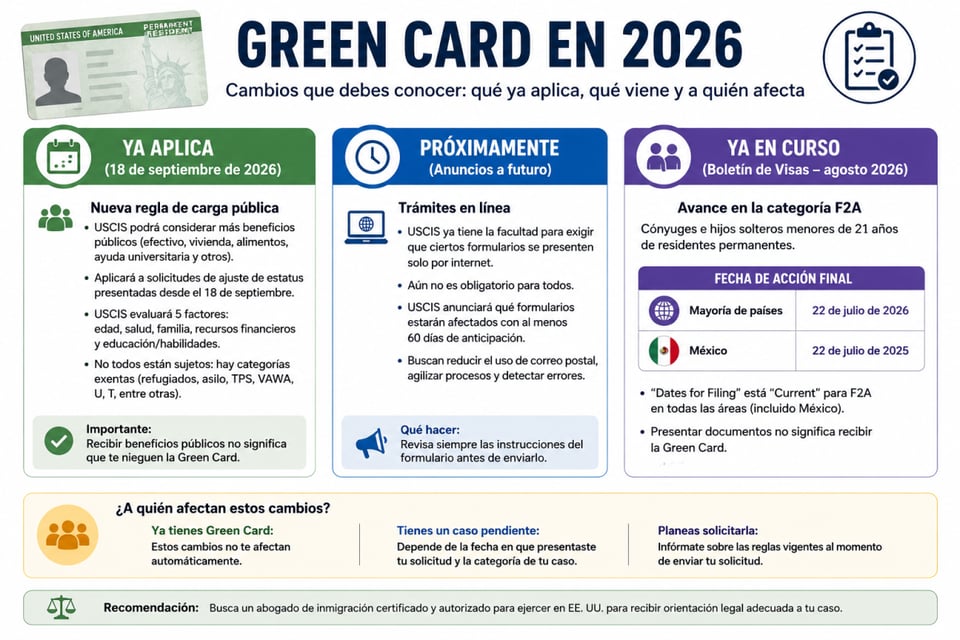
The most concrete change has a date: on September 18, the new «public charge» policy for certain adjustment of status applications will take effect.
DHS eliminated the regulations adopted in 2022 and will give more discretion to officers to evaluate whether certain applicants may depend on government assistance.
The evaluation may consider the applicant’s complete circumstances and a broader range of information related to public benefits.
- The key date: The new rule applies to adjustment of status applications sent or submitted electronically starting September 18.
- The limit: Having received public assistance does not automatically mean losing the possibility of obtaining residency.
Additionally, there are categories exempt from the public charge grounds for inadmissibility. Therefore, the impact must be determined according to the migration route used.
2. Digital Filings Are Not Yet Mandatory for Everyone
Another important change is related to electronic submission. DHS published a rule allowing USCIS to require that certain forms be submitted exclusively online.
This does not mean that all immigration forms must be sent via the internet now. USCIS must identify which forms will be subject to the requirement and establish the corresponding procedure.
Among the forms that may be affected is the I-90, used to replace or renew a Green Card. Other immigration processes may also be incorporated gradually.
- What’s changing: USCIS already has the regulatory authority to impose electronic submission for certain processes.
- What to review: Before sending an application, it’s a good idea to check the current edition of the form, the instructions, the permitted submission method, and the corresponding fee.
3. F2A Families Receive Another Advance in September
There is also news for spouses and unmarried children under 21 of permanent residents, known as category F2A.
The September Visa Bulletin again moved up the final action date: it is now August 22, 2026, for most countries and August 22, 2025, for Mexico. The Dates for Filing table remains «Current» for F2A.
- The difference: Being able to submit documents does not mean that USCIS or a consulate can already approve the Green Card.
- The fact: The Department of State warns that dates may retrogress if demand increases or annual limits are reached.
4. Having a Green Card Is Not the Same as Applying for One
New rules aimed at adjustment-of-status applicants do not automatically apply to everyone who already holds permanent resident status.
For people with pending cases, the applicable instructions may depend on when they submitted their applications and the requirements in effect at that time. Applicants preparing to file should follow the rules in place on the date they submit their application.
There is also no current official basis for the broad claim that all marriage-based Green Card applications now require an in-person interview. USCIS may require an interview depending on the type and circumstances of a case, so the claim should not be presented as a universal requirement without a specific official provision.
- What’s next: September will be especially important due to the entry into force of the new public charge policy and the new Visa Bulletin dates.
The information explains general changes and does not replace legal advice.
The key is to distinguish between an effective rule, an announced measure, and a procedure that USCIS has not yet applied to everyone.
Recommendation: If you have doubts about how these changes may affect your particular case, seek guidance from a duly accredited or authorized immigration attorney in the United States. Avoid relying solely on social media or people who promise guaranteed immigration results.
You May Be Interested In: Does ICE Not Separate Families? The Case of Liam Tadeo Reopens the Controversy
SOURCE: MundoNow / USCIS