US Trade Deficit With Mexico Rises 21% in 2026 Despite Tariffs


Posted on 10/16/26 at 18:40
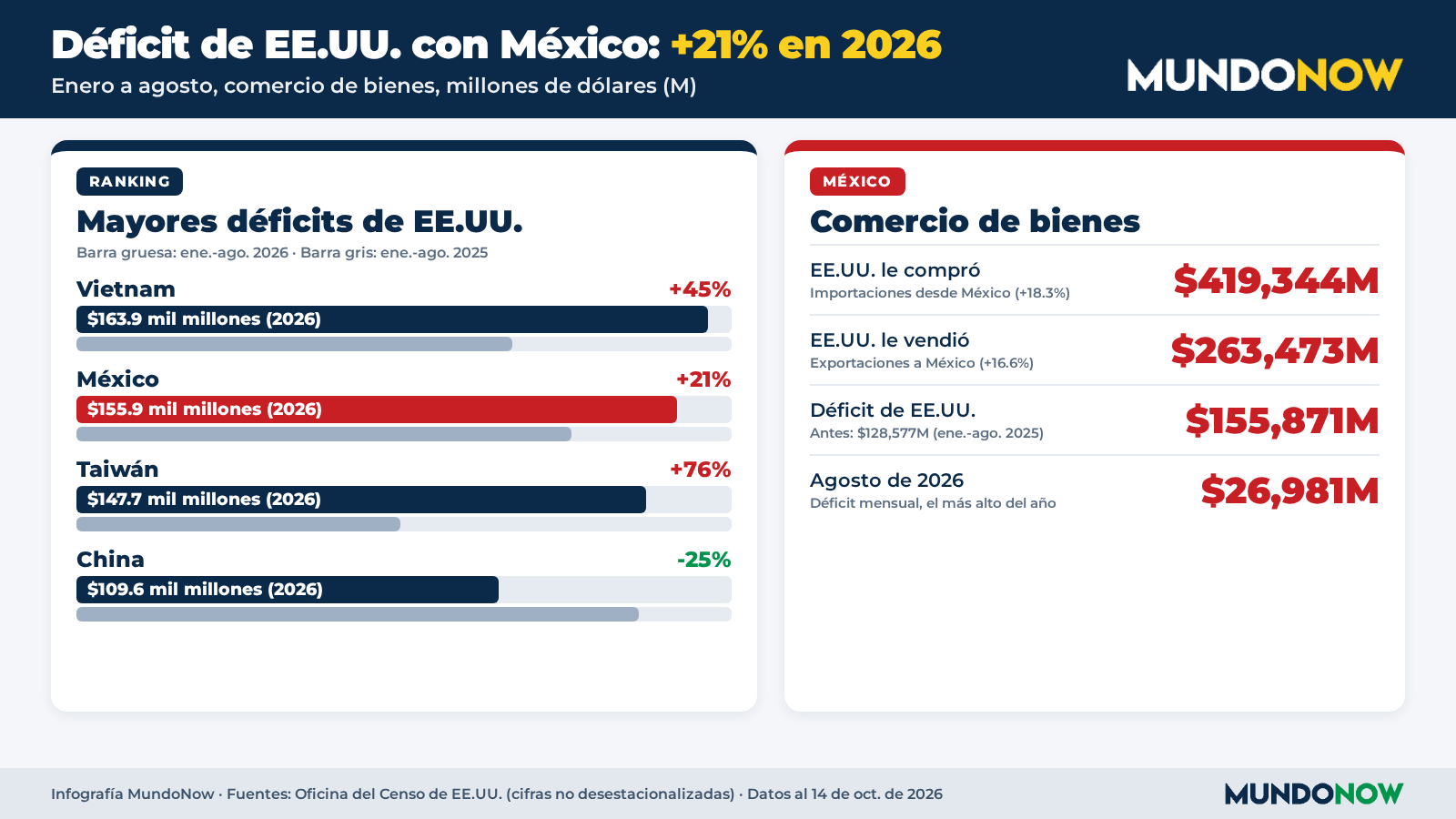
The US trade deficit with Mexico reached $155.871 billion from January to August 2026, a 21.2% increase compared with the same period in 2025, according to data from the U.S. Census Bureau. The increase occurred despite tariffs Washington applies to vehicles, auto parts, steel, and aluminum.
- The U.S. imported $419.344 billion in goods from Mexico and exported $263.473 billion from January to August 2026.
- The deficit with Mexico rose by $27.294 billion, from $128.577 billion to $155.871 billion.
- Mexico has the second-largest U.S. trade deficit, behind Vietnam at $163.904 billion.
Why it matters: The Trump administration uses trade deficits as an argument for tougher trade policies, and according to an analysis published by El Financiero, the Office of the U.S. Trade Representative (USTR) is expected to focus on the deficit with Mexico. What is decided could affect the production chains that connect both countries.
What the US Trade Deficit With Mexico Measures, and What It Doesn’t
A trade deficit in goods occurs when a country buys more products than it sells to another. It is similar to a family budget in which more is spent at a store than is earned from it. The Census figure covers merchandise only and does not include services.
It is also worth noting that trade increased in both directions. Imports from Mexico rose 18.3%, from $354.477 billion, while U.S. exports to Mexico increased 16.6%, from $225.901 billion. The deficit grows because purchases increased by more dollars than sales.
Mexico Among the Largest US Trade Partners
From January to August 2026, Mexico was the leading supplier of goods to the U.S. It was followed by Canada, with $269.645 billion in imports, and Taiwan, with $186.936 billion. Mexico was also the leading destination for U.S. exports, ahead of Canada at $235.972 billion.
The monthly deficit with Mexico reached $26.981 billion in August 2026, the highest of the year. In July, it was $26.310 billion; in August 2025, it stood at $15.998 billion.
Vietnam, Taiwan, and China: The Trade Deficit Map Changes
The largest U.S. trade deficits from January to August 2026 were:
- Vietnam: $163.904 billion, previously $113.054 billion.
- Mexico: $155.871 billion, previously $128.577 billion.
- Taiwan: $147.665 billion, previously $83.908 billion.
- China: $109.621 billion, previously $145.930 billion.
According to Víctor Piz’s column in El Financiero, published on October 14, 2026, the experts he cites warn that part of this shift reflects the redirection of Chinese trade through Vietnam and that Mexico is not the main problem. Piz notes that Mexico is exporting increasing amounts of electronic and computer components because of U.S. demand for technology equipment.
Tariffs and US-Mexico Trade Negotiations
According to Piz, the deficit with Mexico grew despite Section 232 tariffs of 25% on vehicles and auto parts and 50% on steel and aluminum. The analyst argues that securing the removal of those tariffs could be difficult for Mexico if the USTR focuses on the bilateral deficit.
What It Means for Workers, Consumers, and Families
Census data do not measure the effects on prices or employment, so they do not allow conclusions about how the trade deficit affects household finances or jobs. They do show that trade in goods between the two countries is large and growing, with products moving across the border in both directions.
What’s Next
The Census Bureau publishes trade data monthly, so new figures will show whether the US trade deficit with Mexico remains at elevated levels. Trade negotiations with Mexico are continuing.
Sources: U.S. Census Bureau, trade with Mexico; Vietnam; Taiwan; China; Canada; El Financiero (Víctor Piz). Data consulted on October 14, 2026.