Trump Jokes About $5,000 Checks: At Mar-a-Lago, They’d Barely Cover a Hamburger


Posted on 10/29/26 at 09:30
President Trump promised to give Americans money if Republicans win the legislative elections, but jokingly acknowledged that his exclusive club is not affordable.
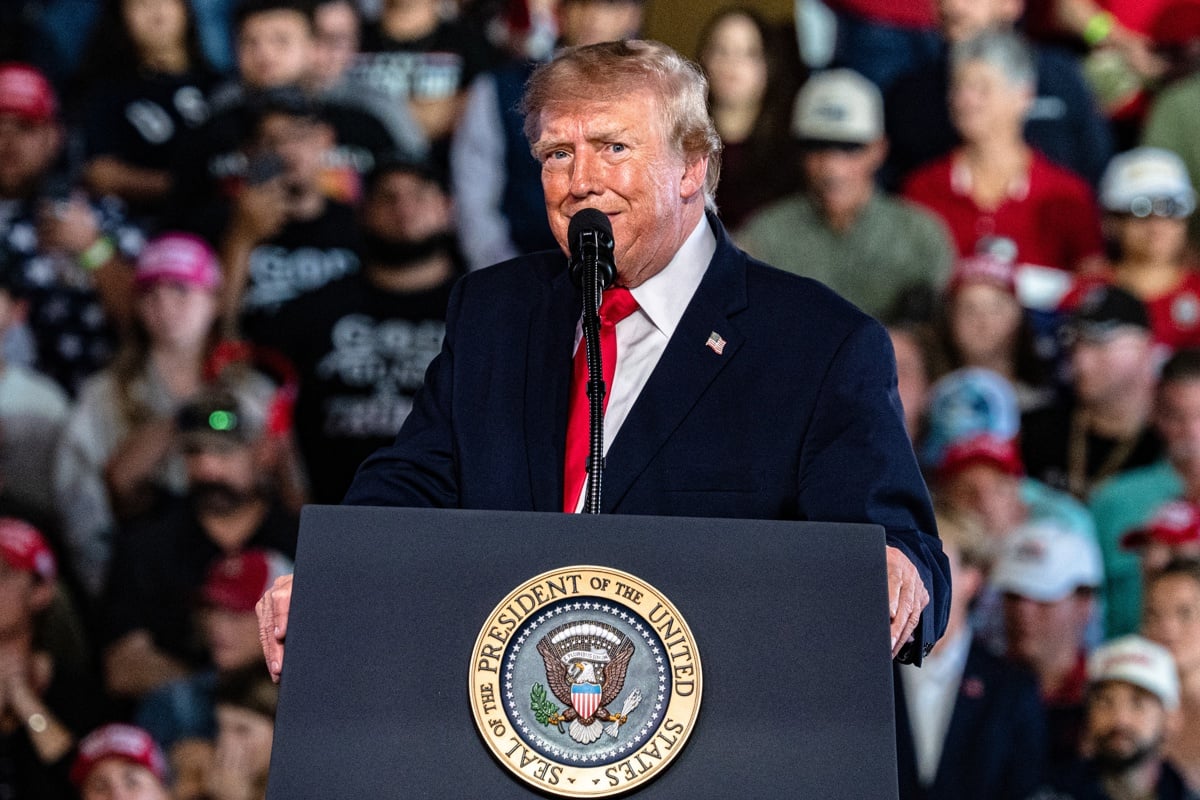
President Donald Trump joked during a rally in Texas that the $5,000 checks he promised Americans would barely be enough to buy a hamburger and a small dessert at Mar-a-Lago, his exclusive resort in Florida.
Why it matters: The statement comes as the cost of living concerns voters, and Trump is conditioning his economic promise on a Republican victory in the November 3 elections.
Trump’s $5,000 Checks: A Joke at Mar-a-Lago
Trump on how people could spend the $5,000 he claims people will receive if Republicans win: «You could even come to Mar-a-Lago…The problem is that for $5,000, the most you’ll be able to buy is a hamburger and maybe a small dessert. I’m not even sure you could buy that. No, don’t go there. That’s not a good place.»
— Bulwark Clips (@BulwarkClips) October 27, 2026
During a campaign event held on October 27 in Corpus Christi, Texas, Trump asked Americans to spend the money they would eventually receive within the country. The president mentioned various tourist destinations, including Mar-a-Lago, before joking about the high prices at his private property.
YOU MAY BE INTERESTED: Democrats lead in early voting participation in states with party registration
«For $5,000, the most you’ll be able to buy is a hamburger and maybe a small dessert,» Trump said, provoking laughter among the attendees. Later, he added that he would not recommend visiting the complex to those concerned about how much they would spend.
The detail: Trump presented the comment as a joke. He did not provide real menu prices or information that would allow verifying that comparison.
The $5,000 Checks Depend on a Republican Victory
Trump joked that $5,000 would buy little at Mar-a-Lago as affordability remains a leading concern for midterm voters. https://t.co/Bq0V8WyqDQ
— Newsweek (@Newsweek) October 28, 2026
Trump’s economic proposal consists of giving $5,000 to each adult American if his party retains control of both chambers of Congress. However, the promise faces political and budgetary obstacles that go beyond the election result.
The fact: Distributing the checks would have an estimated cost of $1.3 trillion for the federal government.
The limit: Congress would have to approve the measure. A Republican victory would not automatically guarantee the payments.
The offer has received criticism from Democrats and some allies of the MAGA movement, who consider it an attempt to influence the vote through economic incentives. So far, the promise does not represent an approved benefit, and there is no confirmed date for distributing the checks.
The Cost of Living Concerns Seven Out of Ten Americans
Trump’s joke about Mar-a-Lago contrasts with the economic difficulties faced by many American households. A Pew Research Center survey conducted in October shows that a majority considers their income insufficient to maintain the lifestyle they want.
60% say their income is not enough to live as they would like.
70% claim to have reduced additional expenses, such as going to restaurants.
Despite these concerns, Trump has defended the strength of the US economy during the campaign. He has also questioned the political use of the term «affordability,» which he has described as a term driven by Democrats.
The War with Iran Also Enters the Economic Debate
During the same rally, Trump claimed that the United States is obtaining significant economic benefits from the situation in the Middle East. According to the president, the US blockade of Iranian ports is favoring energy producers in Texas, Louisiana, and Alaska. Trump also argued that gas prices will eventually decrease, although he did not provide a specific timeline.
What’s next: The November 3 elections will determine control of Congress and put Trump’s $5,000 promise to the test.
Even if Republicans win both chambers, Americans will have to wait for a legislative decision before those checks can become a reality.
Source: USA Today