The Legal Loophole Allowing Billionaires to Live Tax-Free — and the Laws Seeking to Close It



Posted on 10/25/26 at 15:35
While working families pay taxes on every paycheck, American billionaires have found a legal way to live virtually tax-free. Now, federal and state lawmakers are pushing bills to close this loophole — and the money raised could fund programs that directly benefit our communities.
Why It Matters
For you and your family: If you work and earn a salary, you pay taxes. Period. But the ultra-rich operate under different rules. According to data cited by Equitable Growth, some billionaires pay effective tax rates of just 1% on the growth of their wealth — a fraction of what an average family pays.
The Ultra-Rich Strategy: Buy, Borrow, Die
In the financial world, it's known as buy, borrow, die. Its workings are relatively simple:
-
Buy: An investor buys stocks, companies, or other assets that increase in value over the years.
-
Borrow: Instead of selling them and paying taxes on the gains, they take out loans using those assets as collateral. The loan provides cash, but also generates debt and interest.
-
Die: When they pass away, their heirs can receive the assets with a new tax basis equivalent to their market value at the time of death. This can eliminate, for capital gains tax purposes, the gains accumulated during the owner's lifetime.
The strategy doesn't necessarily eliminate all taxes. There may be estate taxes, legal limitations, and financial risks. However, it allows certain accumulated gains to never be subject to capital gains tax.
The result: Generations of wealth that never pay capital gains taxes.
According to research by Edward Fox and Zachary Liscow published by Equitable Growth, Americans with over $100 million in wealth hold $8.5 trillion in unrealized capital gains. To put it into perspective: these 64,000 households have as much unrealized gains as the 84% of the population — that is, 110 million households combined.
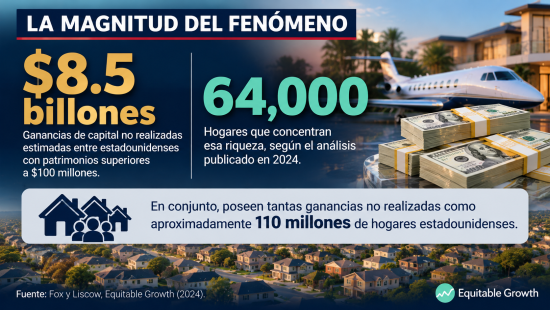
Source: «Closing the billionaire borrowing loophole would strengthen the progressivity of the U.S. tax code» by Maria Monroe, Equitable Growth, February 5, 2024.
URL: https://equitablegrowth.org/closing-the-billionaire-borrowing-loophole-would-strengthen-the-progressivity-of-the-u-s-tax-code
The Bills in Play
Federal Level: Two Democratic congressmen have introduced proposals that seek to tax certain loans backed by large fortunes. While they share the goal of reducing the tax advantages associated with this strategy, their mechanisms are different.
1. ROBINHOOD Act (Redistribution of Billions by Instituting New High-Income Obligations on Overlooked Debt)
– Who introduced it: Congressman Dan Goldman (NY-10)
– What it proposes: A special 20% tax on loans and lines of credit backed by capital assets
– How much it would raise: Approximately $276 billion in 10 years
– What it would fund: Universal pre-K for all 4-year-old children, universal childcare, or fully restore investments in childcare from the American Rescue Plan
As Congressman Goldman stated: «While New Yorkers pay taxes on every paycheck, billionaires live tax-free by borrowing against their stock portfolios, real estate, and art collections without paying a cent.»
Source: «Rep. Dan Goldman Introduces New Tax On Wealthiest Americans Generating An Estimated $276 Billion In Revenue,» Office of Congressman Daniel Goldman, December 4, 2025.
URL: http://goldman.house.gov/media/press-releases/rep-dan-goldman-introduces-new-tax-wealthiest-americans-generating-estimated
2. Pay Your TAB Act (Tax Asset-Backed loans)
– Who introduced it: Congresswoman Laura Friedman (D-Glendale, California)
– What it proposes: A 23.8% tax on asset-backed loans (only amounts over $1 million)
– Protections included: Mortgages, student loans, car loans, and commercial loans are **excluded**
Representative Friedman explained that the 23.8% rate is exactly what these billionaires would pay if they sold their assets — making the system fairer without affecting working families.
Source: «Federal bill would tax the rich taking out asset-backed loans» by Madeline Shannon, The Center Square.
URL: https://www.thecentersquare.com/california/article_fd1eec67-072f-47e8-a4ed-0459037eaf7f.html
—
3. California Takes the Debate to the Ballot
ELECTIONS ON NOVEMBER 3, 2026
California's Proposition 40 proposes a different approach: instead of taxing loans, it would establish an extraordinary tax on large fortunes.
The initiative, officially included on the November 3 ballot, would impose a one-time tax of up to 5% on certain assets of taxpayers with fortunes over $1 billion. The measure would apply to those who were California residents on January 1, 2026. It would generally exclude real estate, certain pensions, and retirement accounts.
Source: https://voterguide.sos.ca.gov/propositions/40
The proposal comes as California faces budget pressures related to federal cuts to health and social programs, including changes approved through federal legislation H.R. 1 of 2025.
The California Legislative Analyst's Office estimates that the tax could generate tens of billions of dollars over several years, although it warns that it could also reduce future state revenues if some billionaire taxpayers leave the state.
What Experts Say
David Kass, Executive Director of Americans for Tax Fairness, noted that «income inequality drives the affordability crisis, with a broken tax system forcing nurses and laborers to pay higher effective tax rates than billionaires.»
A 2025 study by the universities of Michigan and Yale confirmed that the top 1% does use the «buy, borrow, die» strategy, although loans represent only a part of their cash income. An even more common strategy is «buy, save, die» — where the ultra-rich simply have so much cash saved that they don't even need to borrow.
The Central Argument
This isn't about punishing success. It's about basic fairness.
When a teacher, a plumber, or a nurse receives their biweekly paycheck, taxes are already deducted. They have no choice. But when a billionaire needs $50 million to buy a yacht, they simply take out a loan against their Tesla or Amazon stocks — and that money comes to them tax-free.
Bills like ROBINHOOD and Pay Your TAB don't create revolutionary new taxes. They simply close a loophole that allows the richest people in the country to operate under a completely different system than the rest of us.
Is It a Matter of Tax Fairness or Economic Risk?
The debate has two dimensions that deserve attention.
Those who support these reforms argue that the current system allows people with larger fortunes to access economic resources without facing the same immediate tax obligations as those who rely primarily on a salary. They consider that taxing these mechanisms would help fund public services and reduce inequalities.
Critics warn that taxes on loans or wealth could have unintended consequences, including changes in investment decisions, difficulties in valuing assets, litigation, and potential relocation of large taxpayers.
In California, even the California Budget & Policy Center, which identifies reasons to tax large fortunes, recognizes that the revenue would be temporary and that there is uncertainty about its economic and legal effects.
Proposition 40 also faces an electoral complication: Propositions 41 and 42 could prevent its implementation if they receive more favorable votes and the courts determine that their provisions conflict.
The Three Proposals, Side by Side
| Proposal | Tax proposed | Status |
|---|---|---|
| ROBINHOOD | 20% on covered loans | Federal bill introduced in 2025 |
| Pay Your TAB | 23.8% on covered amounts over $1 million | Federal bill introduced in October 2026 |
| Proposition 40 | Up to 5% of certain billionaire fortunes, one-time | On California's November 3 ballot |
The Question That Remains
Is it reasonable for someone to access millions of dollars through asset-backed loans without paying taxes on that money, while another person pays taxes every time they receive their salary?
And if the rules change, how can we ensure that the reforms raise what they promise without causing economic consequences that end up affecting the very public services they aim to protect?
These are the questions that lawmakers — and California voters — will have to consider.
Call to Action
1. Get informed and share: These proposals directly affect how early education, childcare, and health services used by our families are funded.
2. Contact your representatives: Ask them about their position on the ROBINHOOD and Pay Your TAB acts. Your voice matters.
3. If you live in California: Stay informed about Proposition 40 and related proposals (Propositions 41 and 42) that may appear on the ballot.
4. Talk to your community: Many Hispanic families work hard and pay their taxes on time. It's fair to demand that those who have more also contribute their share.
The Bottom Line:
The current system allows the richest to accumulate generational wealth while paying proportionally less than working families. These bills represent a bipartisan and multilevel effort to restore tax fairness. The money raised could transform childcare, education, and healthcare programs — services that directly impact our community.
Sources and References for Publication
-
Equitable Growth — Closing the billionaire borrowing loophole. Edward Fox and Zachary Liscow, February 2024.
-
Office of Congressman Dan Goldman — ROBINHOOD Act. December 2025.
-
Office of Laura Friedman — Pay Your TAB Act. October 2026.
-
California Secretary of State — Official Guide to Proposition 40. November 2026 elections.
Editorial verification: October 25, 2026. The revenue figures are estimates, not guaranteed income. The attribution of the Equitable Growth research was corrected, the exemptions of Pay Your TAB were clarified, and the statement that these initiatives constitute a bipartisan effort was removed, as the two federal proposals cited were introduced by Democratic lawmakers.