New Hampshire Student ID Voting Dispute Goes to Supreme Court Before Election


Posted on 10/16/26 at 15:00
New Hampshire student ID voting at risk as the state is seeking to prevent university credentials from being used as part of voter verification. A court ruling keeps that possibility open under certain conditions.
New Hampshire asked the U.S. Supreme Court to urgently block a ruling that allows student IDs to be used together with other proof to vote on November 3.
- Why it matters: The decision could change which documents college students can present to prove their eligibility to vote, just weeks before the midterm elections.
New Hampshire Seeks to Block Student IDs in Voter Verification
BREAKING: New Hampshire asked the U.S. Supreme Court to block a ruling that lets election officials consider student IDs as proof of a voter’s identity when they register or cast a ballot.
This is the latest GOP push to make it harder for students to vote ahead of Election Day. https://t.co/Bmu11mXplx
— Democracy Docket (@DemocracyDocket) October 15, 2026
The request came after a federal appeals court in Boston declined, by a 2-1 vote, to suspend a ruling favorable to students.
Secretary of State David Scanlan argues that election officials need uniform guidance to apply the current law.
- The fact: HB 323, signed by Republican Governor Kelly Ayotte, eliminated student IDs as sufficient proof on their own to establish eligibility to vote.
However, federal Judge Joseph Laplante determined that the change did not prohibit presenting university credentials together with other documents.
The judge concluded that Scanlan had interpreted the law too restrictively by completely barring their use at polling places.
New Hampshire Student ID Voting Dispute Pits State Against Youth Voting Advocates
[caption id="attachment_1696927" align="alignnone" width="1224"]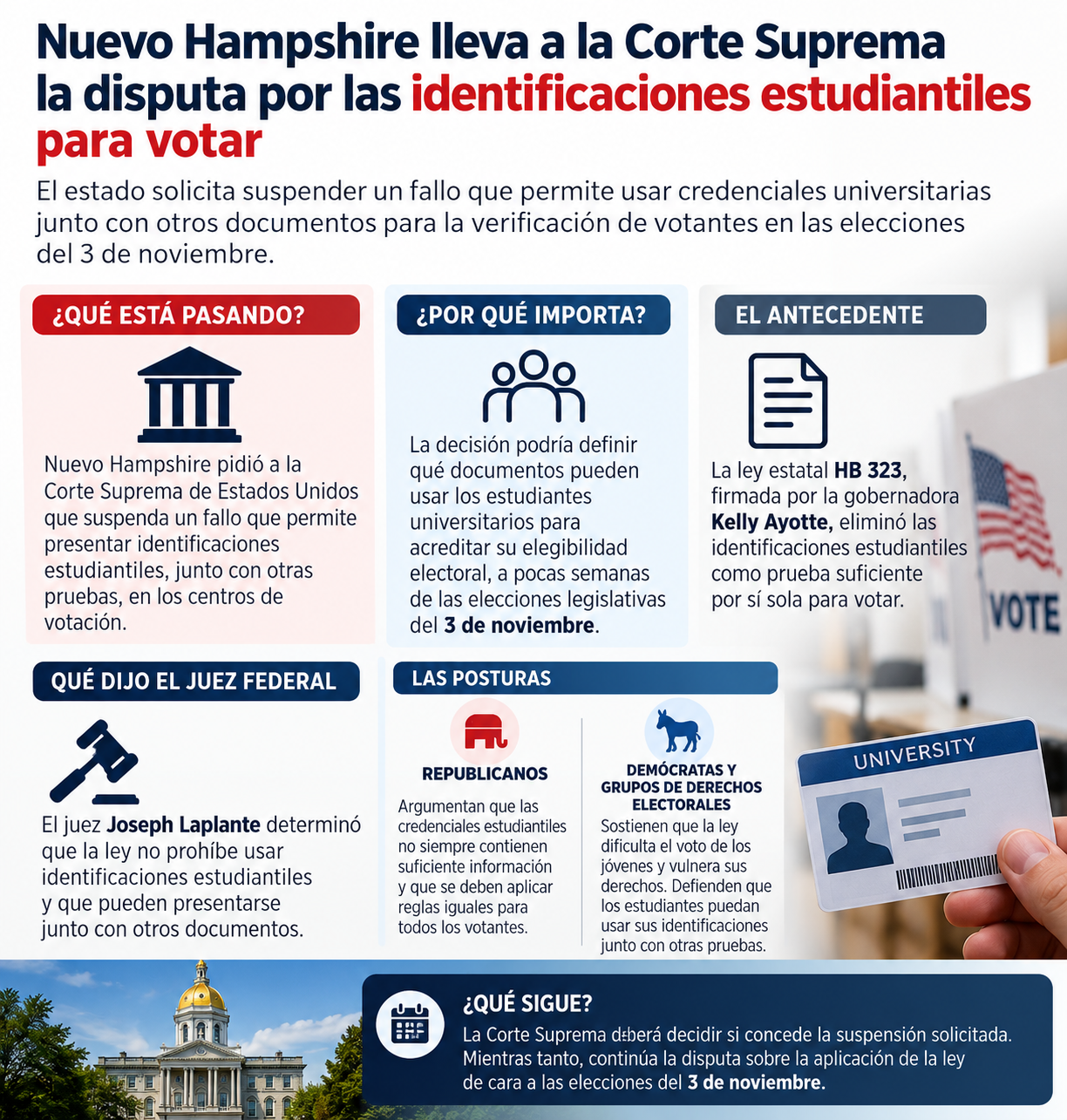 New Hampshire Student ID Voting Dispute Goes to Supreme Court Before Election - Illustration: AI-generated — MundoNow[/caption]
The Open Democracy Coalition, a nonpartisan organization, challenged the law, arguing that it harms young voters and undermines constitutional protections.
Its attorneys argue that the court ruling protects eligible students who lack other forms of identification or face financial barriers to obtaining them.
YOU MAY BE INTERESTED: Republicans Fear Losing House Ahead of 2026 Midterm Elections
– The difference: The ruling does not make student IDs sufficient documents on their own. It allows them to be presented together with other legally accepted proof.
The state Department of Justice defended its emergency request and emphasized the importance of providing clear instructions to local election officials.
Michael Garrity, a department spokesperson, confirmed that the state went to the Supreme Court to request that the ruling be suspended.
Republicans Defend Restrictions, Democrats Denounce Barriers
The Republican National Committee supported Scanlan's position through a court filing in the litigation.
Republican lawmaker Ross Berry argued that student IDs do not always contain enough information to show that a person meets voting requirements.
Berry also questioned whether courts should alter the application of election rules when only a few weeks remain before Election Day.
– The Democratic stance: Critics argue that the law makes it harder for college students to participate and disproportionately affects a segment of the electorate that often supports Democratic candidates.
The controversy pits two competing interpretations against each other: the need to properly verify voter eligibility and the right of students to present complementary documentation.
Supreme Court Decision Pending Before November 3
The emergency request seeks to suspend the effects of the lower court rulings while the dispute over the application of HB 323 continues.
A stay would allow the state to apply its more restrictive interpretation while the litigation proceeds. If the request is denied, the challenged ruling would remain in effect.
– What's next: The Supreme Court must decide whether to grant the requested stay. The petition does not mean that the justices have already ruled on the merits of the case.
For students, the practical difference lies in which documents they can present to election officials.
The decision will also determine what instructions local authorities must follow when verifying voter eligibility during the election.
Source: Union Leader.