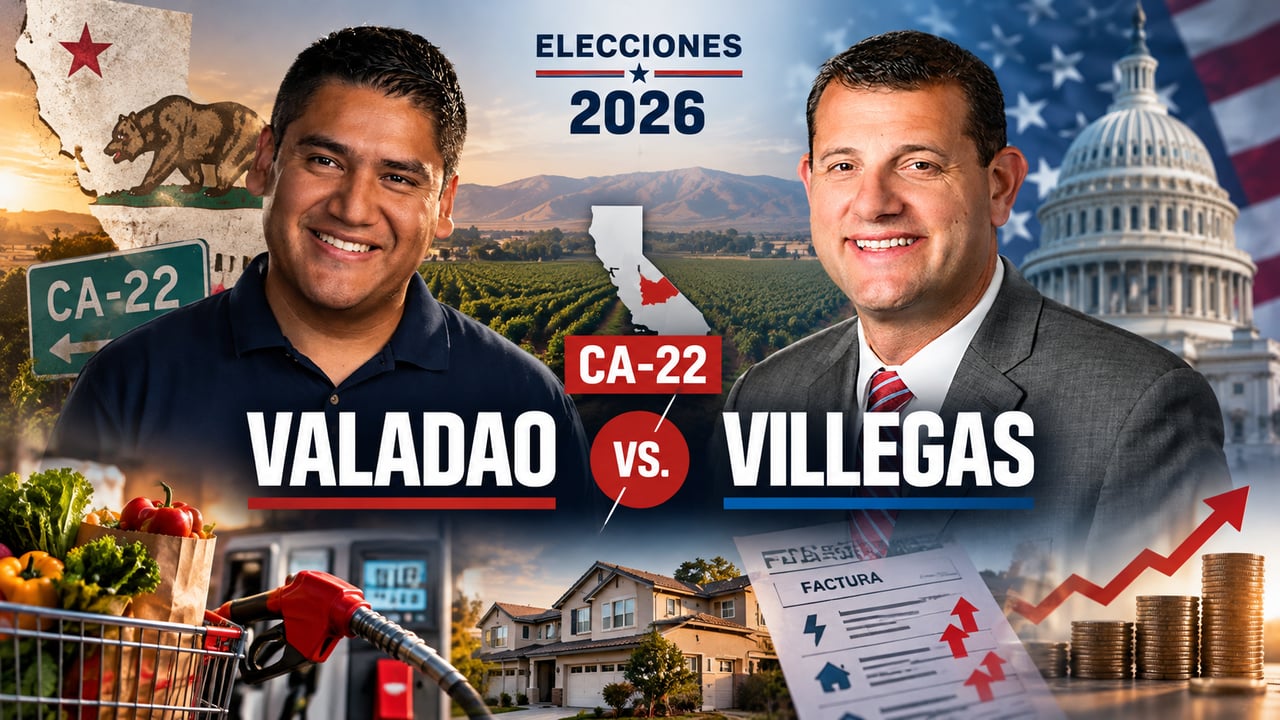
Valadao (R) vs. Villegas (D): Health, Immigration, and the Pocketbook of a 65% Latino District


Posted on 10/11/26 at 10:55
In CA-22, taxes, Medi-Cal, food, agriculture, and immigration are not separate debates. They all end up on the same family’s bill.
Why it matters
CA-22 concentrates several of the questions we’ve been following in DECISIÓN 2026: what does the Latino electorate want today, and what can politicians really do about the cost of living?
- 65%: proportion of Latino citizens of voting age in the new district, according to UnidosUS.
- ~200,000: registered Latino voters, according to the same source.
- 8 points: margin by which Donald Trump would have won the district under the new 2024 lines, according to UnidosUS.
READ ALSO: Ciscomani (R) vs. Mendoza (D): 95,000 Latino voters, two generations, and two visions for Arizona
The candidates
David Valadao, a Republican, is a congressman and dairy producer. Randy Villegas, a Democrat, is a university professor and community organizer, the son of Mexican immigrants.
Both talk about working families. The difference lies in what role the government should play and what costs they are willing to accept to achieve their goals.
Zoom in: Medi-Cal
Valadao voted in favor of the 2025 federal reconciliation law. Explaining his vote, he said that he had eliminated Medicaid proposals that he considered particularly harmful, highlighted $50 billion for rural health transformation, and maintained that the law protected Medicaid for vulnerable populations. He also acknowledged concerns about changes in its financing.
The CBO projects a broader impact: the changes would reduce federal Medicaid spending by around $1.2 trillion between 2026 and 2035 and Medicaid enrollment by 13.1 million people in 2035 compared to its previous projection. It also estimates $211 billion less in SNAP spending during that period.
Villegas proposes reversing the health changes and moving towards guaranteed coverage. That is a clear policy direction; the cost, financing, and design would depend on the legislation that manages to pass.
What changes for a family
California already reports that, starting January 1, 2027, certain adults aged 19 to 64 covered by the Medi-Cal expansion will have to meet work, study, training, or community service requirements, except for exemptions.
For a seasonal agricultural worker, the question stops being ideological: does he conserve coverage?, what documents will he have to present?, how are his hours verified?, what happens to a rural hospital if financing changes?
The other half: taxes
Valadao points out that the same law contains tax benefits, including changes for certain tips and overtime, the Child Tax Credit, deductions for seniors, and investments in agriculture and water.
Here appears the tradeoff that we explained in our analysis of the cost of living: the same family may receive a tax benefit and, at the same time, face changes in health or food assistance. The result depends on income, children, employment, and coverage.
Between the lines: immigration + agriculture
The Central Valley depends on agricultural workers and closely follows the migration debate. Valadao has supported a conditional path to legal status or citizenship and reforms for agricultural workers, along with greater emphasis on expelling immigrants who commit serious crimes. Villegas supports a path to citizenship for long-term residents, border security, and greater oversight of immigration enforcement.
It’s not simply «open border» versus «closed border». The difference lies in how to combine security, legalization, law enforcement, and the labor needs of agriculture.
Reality check
Medicare is not Medicaid. Medicare mainly covers older adults and certain people with disabilities. Medicaid — Medi-Cal in California — covers low-income residents and other eligible groups. And in a closely divided House, those policy differences can depend on very few votes.
As of September 28, the House had 218 Republicans, 214 Democrats, one independent, and two vacancies. Valadao already has a record that can be examined: he voted in favor of the 2025 reconciliation law, although he said he had concerns about several Medicaid provisions and highlighted changes that he helped modify or finance.
Villegas, as a challenger, does not have a voting record in Congress; what can be evaluated are his proposals and how he says he would govern. Before voting, compare both: not just what they promise about prices and health, but the vote they could bring on taxes, Medicaid, SNAP, immigration, agriculture, energy, and federal spending.
What to compare
Valadao puts more weight on tax relief, agriculture, water, eligibility requirements, and lower federal spending, while maintaining that he protected vulnerable populations. Villegas puts more weight on preserving or expanding health coverage and economic support, in addition to a broader path to legalization for long-term residents.
The data does not turn that tradeoff into an automatic answer. It does allow the voter to identify what changes for their household and what part of each campaign’s message can be verified.
For electoral context and official resources, visit elections.mundonow.com.
Sources
UnidosUS — Competitive Districts
Ballotpedia — CA-22 general election overview
Rep. David Valadao — statement on 2025 reconciliation vote
CBO — Budget and Economic Outlook 2026–2036
Randy Villegas campaign — issues
U.S. House Clerk — House at a Glance / 2026 roll-call votes