María Corina Machado Returns to Venezuela: A Test for the Country’s Political Transition


Posted on 10/25/26 at 13:22
After nearly 10 months abroad and several failed attempts to return, opposition leader María Corina Machado is back in a deeply transformed Venezuela. Nicolás Maduro is no longer in power, but Chavismo continues to govern, and Washington maintains decisive influence over the political process.
What Happened Today
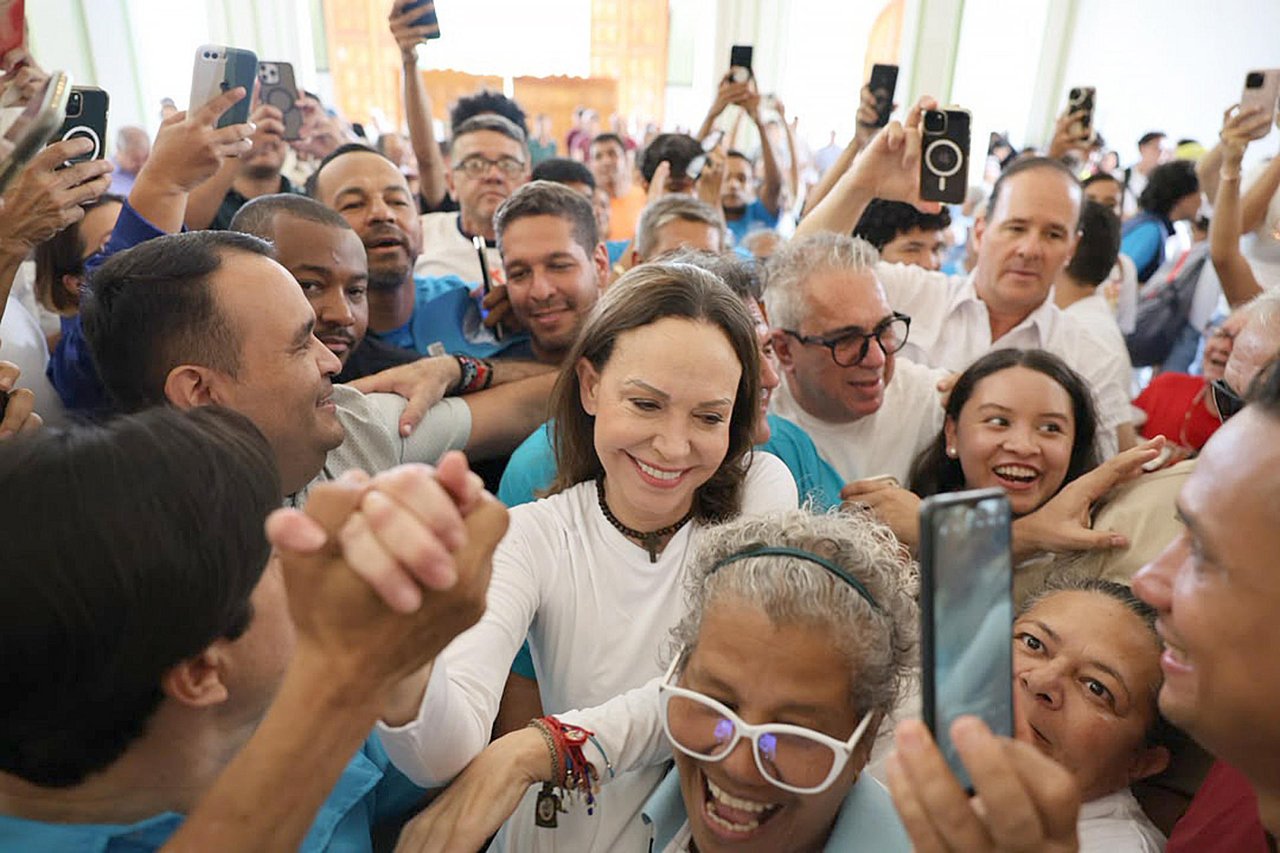
Venezuelan opposition leader María Corina Machado reappeared publicly on Sunday, October 25, at the Santuario de la Divina Pastora in Barquisimeto, Lara state, where supporters greeted her after nearly 10 months abroad.
The international agency EFE documented the meeting with a photograph provided by the Vente Venezuela party, showing Machado surrounded by followers. The image constitutes evidence of her presence at the sanctuary, although it was facilitated by her political organization and not taken directly by an EFE photographer.
Why It Matters
María Corina Machado, winner of the 2025 Nobel Peace Prize and one of the main figures of the Venezuelan opposition, confirmed her return to Venezuela on Sunday, October 25, with a message of just five words published on X: “Estoy aquí. Con ustedes” (I’m here. With you).
Her return comes after nearly ten months abroad and at least seven failed attempts to enter the country. The announcement was confirmed by her political ally Edmundo González Urrutia, the opposition’s presidential candidate in the contentious 2024 elections.
But the true significance of her return goes beyond her physical location. Machado is back in a country where a military operation ousted Nicolás Maduro in January 2026, but where power remains in the hands of Delcy Rodríguez, Maduro’s former vice president, with the support of the Trump administration.
The question now is whether her return will open space for a democratic transition through elections, or whether the opposition will continue to be marginalized from decisions about Venezuela’s future.
A Return After Months of Obstacles
Machado left Venezuela in December 2025 for Norway, after months in hiding following the 2024 electoral crisis.
Since then, she has engaged in international activities and attempted to return on several occasions. According to her team, at least seven attempts to enter the country by air, sea, and land were thwarted in recent months.
Journalist David Alandete of the Spanish newspaper ABC reported on Sunday that the return was made possible through a diplomatic operation involving several countries and Washington’s knowledge.
Alandete also stated that he had consulted with President Donald Trump weeks earlier about Machado’s possible return and that Trump had expressed confidence that it could be achieved. So far, not all the details of that operation have been publicly disclosed, and there is no official US confirmation of its terms.
Initial reports suggested a possible public reappearance by Machado at the Santuario de la Divina Pastora in Lara state. However, RTVE later reported that it had confirmed her presence in Caracas. The location of her first public appearance should be treated with caution until images or direct confirmation are available.
Venezuela Has Changed During Her Absence, But How Much?
When Machado left the country, Nicolás Maduro was still president. A month later, a US military intervention led to his ouster.
However, the change in leadership did not result in an immediate transfer of power to the opposition that had questioned the results of the July 2024 presidential elections.
Delcy Rodríguez assumed the interim presidency and has maintained control of the executive with Washington’s support. Until Sunday, no date had been set for new presidential elections. At the same time, Machado and her allies continued to demand an electoral process that would allow the country’s political future to be defined.
This situation reveals a significant contradiction: the United States intervened militarily to remove Maduro from power but has since worked with figures from his own government. At the same time, the main opposition leaders remained outside the transition process.
The US administration has prioritized economic and political stabilization. The opposition, on the other hand, insists that a democratic transition requires elections and popular legitimacy.
Edmundo González Also Announces His Intention to Return
Machado’s return could be followed by that of Edmundo González Urrutia, who has been living outside Venezuela since September 2024. González publicly celebrated the news and announced his intention to meet with Machado soon in Venezuelan territory.
The opposition leader, who claims victory in the 2024 presidential elections, believes that both should participate in the political process that will define the country’s future.
The possibility of the two main opposition figures returning to act from within Venezuela introduces a new political dimension. Until now, much of their activity had been developed from outside, while negotiations and government decisions continued without their direct participation.
What Does It Mean for Venezuelans Inside and Outside the Country?
For millions of Venezuelans who abandoned their country during the years of economic and political crisis, the evolution of the transition may have consequences for deeply personal decisions: returning, reuniting with family, recovering property, or rebuilding life projects.
However, the return of a political leader, important as it is, does not, by itself, guarantee that these conditions will change.
Questions persist regarding political freedoms, institutional independence, guarantees for the opposition, and the call for presidential elections.
For the Venezuelan diaspora in the United States, particularly in communities like southern Florida, Machado’s return also raises a question about the relationship between Washington and Caracas: to what extent will the US facilitate an open political process for all Venezuelan forces, even when its economic and diplomatic priorities are different?
What’s Next: Three Questions for the Transition
Machado’s return obliges us to consider three issues that will determine the next stage of Venezuela’s political transition:
-
Will there be presidential elections? The opposition demands an electoral calendar, but so far, no date has been announced.
-
What role will Washington play? The Trump administration maintains a working relationship with the interim government of Delcy Rodríguez. It remains to be seen how it will incorporate the demands of Machado and González.
-
Can the opposition participate with guarantees? Their presence in Venezuela does not automatically resolve the institutional and political obstacles that have marked the last few years.
The Return Is Not the End of the Transition
María Corina Machado’s return to Venezuela marks a significant event after months of exile and a political transformation that unfolded while she was outside the country.
But her return also highlights a reality: the ouster of Nicolás Maduro has not resolved who should govern Venezuela or how its citizens should decide.
For Machado and her allies, the next challenge will be to turn their return into effective political participation. For the interim government, it will be to respond to demands for democratic representation. And for Washington, it will be to reconcile its stability goals with the demand for free elections.
The question that remains is as simple as it is profound: will it be the Venezuelans who finally decide Venezuela’s future?
Verified Sources — October 25, 2026
-
Associated Press — Machado’s Return and Democratic Challenges. Context of the interim government and transition.
-
EL PAÍS — María Corina Machado Returns to Venezuela: failed attempts to return and Washington’s role.
-
RTVE — Machado Returns After Almost Ten Months. Confirmation of her return and information about her location.
-
EFE — Previous Attempts to Return to Venezuela. Documented background.
-
El Estímulo — The Return and David Alandete’s Statements. Attributed information about the diplomatic operation.