Seven States to Decide Senate Control for Next Two Years


Posted on 11/03/26 at 13:30
Lowdown: Texas, Michigan, Ohio, and four other states are home to some of the most competitive elections on November 3. The outcome will define the balance of power in Washington.
Why it matters: Senate control will determine which party leads legislative committees, pushes bills, and oversees federal judge confirmations. For millions of Hispanics, decisions on immigration, economy, healthcare, and labor rights could be directly affected.
The Essentials
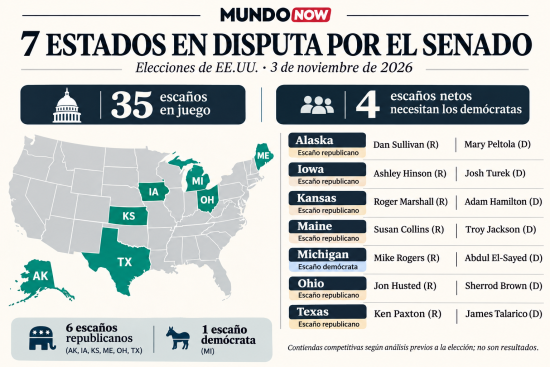
- 35 Senate seats are up for grabs in the November 3 elections.
- Seven states are home to some of the most competitive contests: Alaska, Iowa, Kansas, Maine, Michigan, Ohio, and Texas.
- Six of those seats are currently held by Republicans and one, Michigan, belongs to the Democrats.
- Democrats need to win four net seats to reach a majority of 51 senators, provided they hold onto their other seats.
The Big Picture: A Battle for Washington
Republicans came into these elections with a majority of 53 seats, compared to 47 for the Democratic bloc, including two independents who vote with the party.
The arithmetic is simple, but the electoral path is not.
Democrats need to take at least four net seats from Republicans to achieve a majority of 51. If the Senate is tied 50-50, Vice President JD Vance may cast tie-breaking votes.
Historically, midterm elections often pose a challenge for the president’s party. However, the distribution of seats and the particularities of each state can produce results that differ from the national trend.
The Seven States to Watch
| State | Top Candidates | Current Seat |
|---|---|---|
| Alaska | Dan Sullivan (R) vs. Mary Peltola (D) | Republican |
| Iowa | Ashley Hinson (R) vs. Josh Turek (D) | Republican |
| Kansas | Roger Marshall (R) vs. Adam Hamilton (D) | Republican |
| Maine | Susan Collins (R) vs. Troy Jackson (D) | Republican |
| Michigan | Mike Rogers (R) vs. Abdul El-Sayed (D) | Democrat |
| Ohio | Jon Husted (R) vs. Sherrod Brown (D) | Republican |
| Texas | Ken Paxton (R) vs. James Talarico (D) | Republican |
Source: electoral ratings and coverage of contests as of November 2, 2026. Competitiveness categories may vary among analysts.
Texas: Immigration, Economy, and Representation
Texas has one of the largest Hispanic populations in the country, with a community that makes up approximately 40% of its residents.
The contest between Republican Ken Paxton and Democrat James Talarico pits two different approaches to immigration, government role, and economic priorities against each other.
The outcome will have implications beyond Texas: the next senator will participate in federal decisions on border security, migration legislation, taxes, and healthcare.
Michigan and Ohio: Two Industrial States Under Pressure
In Michigan, Republican Mike Rogers and Democrat Abdul El-Sayed are competing for an open seat currently held by the Democratic Party.
In Ohio, Republican Senator Jon Husted faces Democrat Sherrod Brown, who is seeking to return to the Senate.
Both states have experienced intense debates over manufacturing, employment, inflation, and the future of the automotive industry.
For working families, decisions on trade, wages, and healthcare costs are just as relevant as national discussions on immigration.
Alaska, Iowa, Kansas, and Maine: The Other Four Contests
In Alaska, Mary Peltola is trying to unseat Republican Senator Dan Sullivan. In Iowa, Ashley Hinson and Josh Turek are competing for an open seat.
Kansas pits Republican Senator Roger Marshall against Adam Hamilton, while in Maine, Republican Susan Collins is seeking to retain her seat against Troy Jackson.
These elections show that the battle for the Senate is not limited to states traditionally considered decisive in presidential elections.
What’s at Stake for Hispanics
Immigration: The Senate can promote, modify, or block migration reforms, in addition to overseeing federal agency policies.
Family Economy: Senators vote on taxes, public spending, and federal programs that affect workers, families, and small businesses.
Healthcare: Legislation on medical insurance, Medicaid, and federal subsidies can change the costs and access to healthcare.
Justice and Civil Rights: The Senate confirms federal judges, including Supreme Court magistrates, whose decisions can affect migration, labor, and constitutional issues.
The Bottom Line
The outcome will not depend solely on which party wins the most of these seven contests, but on which seats change hands and which remain with their current party.
Other states outside this list, such as North Carolina, Georgia, and New Hampshire, will also be important.
What’s Next: Initial projections may be available on election night, but some close contests may require more time to count mail-in, provisional, and other valid votes.
The final composition of the Senate will determine how much leeway the White House will have to push its agenda and how much power the opposition will have to oversee or modify it.
Sources
- The Center Square — Seven states that could determine control of the U.S. Senate.
- Cook Political Report — 2026 Senate Race Ratings, updated November 2, 2026.
- Inside Elections — 2026 Senate Elections.
- Financial Times — US midterms 2026: your guide to election night, November 3, 2026.
- Associated Press — Coverage of the November 3, 2026, midterm elections.