New Populism Shifts Election Battle: Republicans and Democrats Target Big Companies


Posted on 09/23/26 at 18:00
Six weeks before the 2026 midterm elections, healthcare costs are gaining prominence and pushing candidates from both parties to confront powerful industry players.
Republicans and Democrats are putting pharmaceutical companies, insurers, and other healthcare industry actors at the center of several key congressional campaigns. Axios describes the trend as a new form of populism centered on healthcare costs.
Why it matters: only 49% of U.S. adults are classified as «Cost Secure,» meaning they can consistently afford quality healthcare and needed medications, according to the West Health-Gallup index published in June.
Healthcare Costs Reshape the 2026 Elections
Midterms’ new populism: Candidates vow to take on health industries https://t.co/SJj9zM8lWr
— Adriel Bettelheim (@abettel) September 22, 2026
The debate is no longer focused solely on defending or repealing the Affordable Care Act, also known as Obamacare.
Candidates with very different policy proposals are now competing to show they are willing to confront insurers, pharmaceutical companies, hospitals, or pharmacy benefit managers.
The fact: among Hispanic adults, only 32% are classified as Cost Secure against healthcare expenses, compared with 55% of White adults.
Concerns over affordability help explain why healthcare is taking up significant space in campaign advertising in competitive races.
Cook Political Report and AdImpact track the issues featured each week in ads from competitive House and Senate races.
Michigan Shows Two Approaches to the Same Problem
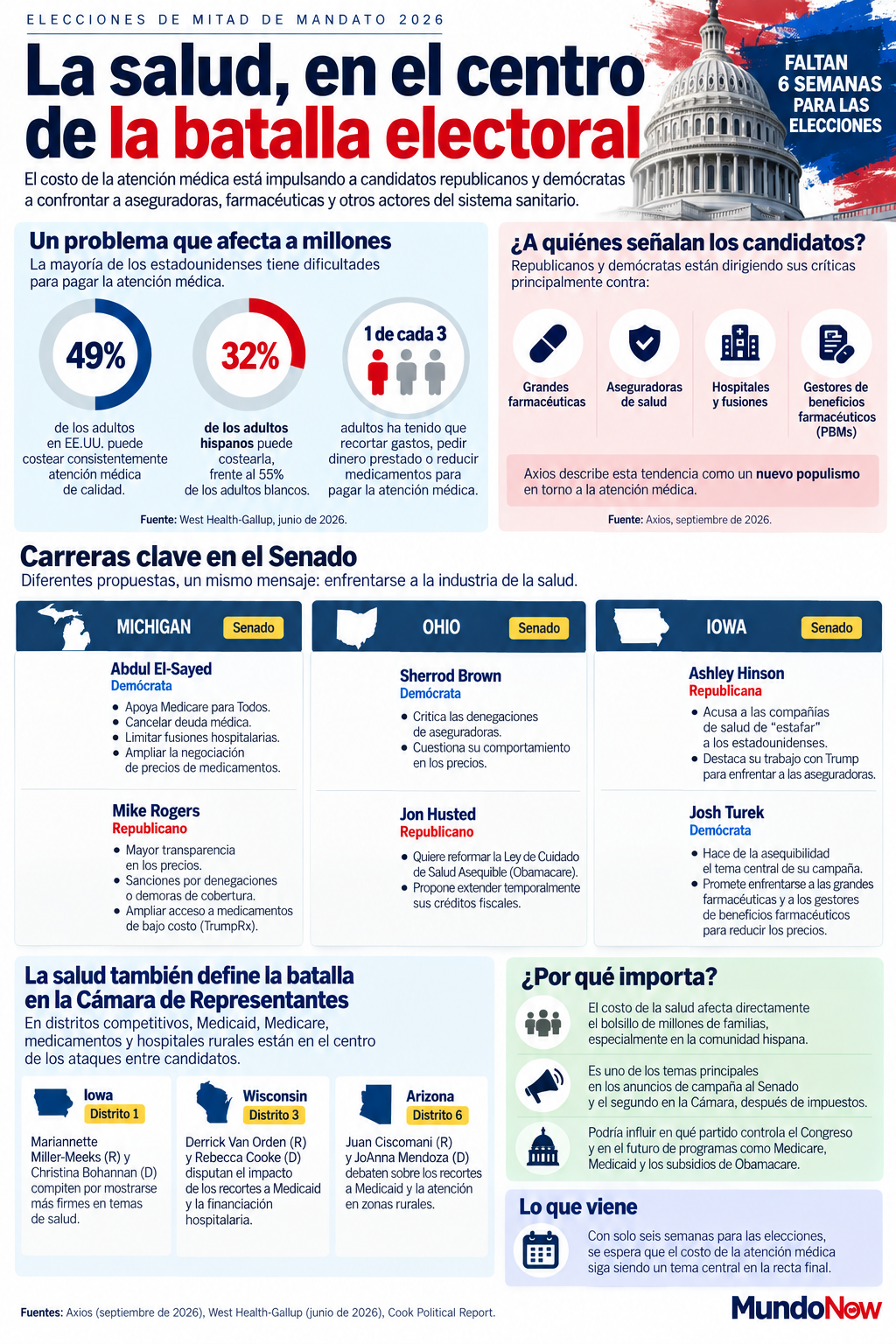
The Michigan Senate race highlights the policy differences behind this anti-industry rhetoric.
Democrat Abdul El-Sayed supports Medicare for All, canceling medical debt, limiting hospital mergers, and expanding Medicare’s ability to negotiate drug prices.
YOU MAY BE INTERESTED: Supreme Court Blocks Trump: What’s Next for Mail-in Voting in 2026
Republican Mike Rogers proposes greater transparency around prices negotiated between hospitals and insurers, along with penalties for certain excessive coverage denials or delays, according to Axios.
- The difference: shared criticism of healthcare industry actors does not mean shared policy solutions. Medicare for All remains a significant dividing line between the two candidates.
The 2026 elections contest has also become personal. El-Sayed has questioned Rogers’ ties to the pharmaceutical industry, while Republicans have portrayed the Democrat’s positions as too progressive.
Iowa and Ohio Feature Similar Anti-Industry Messages
In Iowa, Republican Ashley Hinson and Democrat Josh Turek both use messages aimed at powerful healthcare interests, although they propose different responses.
Turek centers his campaign on affordability and promises to take on large pharmaceutical companies and pharmacy benefit managers to lower healthcare costs.
Hinson, for her part, has accused healthcare companies of overcharging consumers and highlights her work with Trump against insurers.
Another front: in Ohio, Sherrod Brown focuses on insurer denials and pricing practices, while Jon Husted proposes changes to Obamacare and a temporary extension of enhanced tax credits.
Healthcare Also Enters Competitive House Races Before the November Elections
The pattern also appears in competitive districts in Iowa, Wisconsin, and Arizona, where Medicaid, Medicare, prescription drugs, and rural hospitals feature prominently in campaign attacks.
In Iowa, for example, Mariannette Miller-Meeks and Christina Bohannan accuse each other of favoring healthcare interests or harming access to care.
- What’s next: with six weeks remaining before the November elections, healthcare costs will continue competing with taxes, the economy, and other issues for voters’ attention.
The notable development is not simply that healthcare has returned as an election issue. Candidates from both parties are increasingly channeling voter concerns about affordability into criticism of different parts of the healthcare industry.
Sources: Axios, Real Clear Health.